I am in earnest -- I will not equivocate -- I will not excuse -- I will not retreat a single inch -- AND I WILL BE HEARD.
-William Lloyd Garrison
First editorial in The Liberator
January 1, 1831

Saturday, January 1, 2022

LET US NOW PRAISE OUR DEPARTED ONES: AN APPRECIATION FOR THREE UNIQUE SOULS RECENTLY SEPARATED FROM US

Summary: it has been a tough December. We’ve lost Archbishop Desmond Tutu, separated from us at the age of 90. Joan Didion died of Parkinson’s disease two days before Christmas at the age of 87, and yesterday morning we lost Betty White, at the marvelous age of 99. What a month.

----------------------------------------
Cathedral City, December 31, 2021. The last week has been rather tough. Christmas this year has been bookended as it were by the separation from us of a number of individuals who enlarged the frontiers of humanity.

Two days before Christmas, Joan Didion passed away from Parkinson’s disease at the age of 87. Her life as a Californian, as a writer, and as a Californian writer, was in its way hugely significant. Joan was one of a stable, as it were, of Californian writers who, in various ways, helped to illustrate our Californian reality to a larger nation and indeed to the world upon which we have been so very influential during the last hundred years. Like John Steinbeck or William Saroyan, Joan Didion helped make California comprehensible to our larger American nation and to the world.

There is something profoundly Californian in Joan’s quotation about Blue Nights, from her book of the same name:

    “During the blue nights you think the end of day will never come. As the blue nights draw to a close (and they will, and they do) you experience an actual chill, an apprehension of illness, at the moment you first notice: the blue light is going, the days are already shortening, the summer is gone...Blue nights are the opposite of the dying of the brightness, but they are also its warning.”

There is something in Didion’s writing that you can’t quite put your finger on, an apprehension of something unusual, yet quotidian. Anyone who has lived in California, whether as a native or as a long time immigrant from somewhere else, will understand, yet not necessarily be able to verbalize, what Joan Didion understood and could verbalize.

Yet, as much as Joan Didion could write about things that enlightened her readers about what it meant to be Californian, she could also remind her readers that California could be anything but hedonistic: “It kills me when people talk about California hedonism. Anybody who talks about California hedonism has never spent a Christmas in Sacramento.”

There is something so utterly Californian in Joan Didion’s writing: influenced by Henry James and Ernest Hemingway, her writing is nonetheless sui generis. At some point some writer may come along and be compared to Joan Didion. But in reality, we shall not see her like again.

If, two days before Christmas we were somewhat taken aback to have been separated from Joan Didion, Boxing Day, the Feast of St. Stephen the Protomartyr, confronted us with the passing away of the Most Rev. Desmond Mpilo Tutu. Ironically, Archbishop Desmond Tutu is the only one of the three people I appreciate today whom I actually met. He was in Los Angeles and happened to visit my parish church, where on a quiet evening, he celebrated the sacrament for a small congregation. I shall not soon forget the experience of receiving the Body of Christ from Desmond Tutu’s archiepiscopal hands. He could not stay long, and left almost immediately after the service was concluded, but sometimes one’s memories come not from his moral witness to thousands, but from his simple, basic exercise of his priestly ministry.

That simple exercise of ministry has stayed with me across more than a quarter of a century. And it has stayed with me for the simple reason that in a way it is become a stay of my faith. Desmond Tutu did not know me from Adam’s house cat. In fact, very few, if any of the 12 or 13 people gathered that night in the Lady Chapel were known to Archbishop Tutu. But we were, black, white, Asian and Pacific Islander, gay and straight, abled and disabled, all the beloved people of God. And all of us shared in God’s gifts to God’s people that evening, gathered as we were around the Lord’s table, as if we were in the Upper Room itself. That sharing of that sacrament, that reminder that an archbishop can be in that moment a priest ministering to God’s people became, for all of us, a reminder that our faith in He who came to save the world is among us always: “For God so loved the world, that he gave his only begotten Son, that whosoever believeth in him should not perish, but have everlasting life.” John 3:16

Yet, Desmond Tutu was not just a simple priest. To speak of South Africa, to understand the enormous, almost miraculous change that took place in that country without civil war, without violence, without repression, without the vast streams of refugees, without recrimination, and without reprisal, is necessarily to speak of the achievements of people such as Desmond Tutu.

When Nelson Mandela was rotting in jail on Robben Island under the apartheid regime, it was accepted that South Africa would become a black majority ruled country, but it was also accepted that the transition to black majority rule would be accompanied by bloodbaths, massacres, and metaphorical mountains of skulls. No one imagined that the transition from white minority rule to black-multiracial rule would happen easily or without bloodshed. The riots, the bombs, the “necklacings,” in which flaming tires would be placed over the heads of accused black collaborators, all of these seemed to be indicators of the horrors –the-thought-to-be-inevitable-horrors– that awaited South Africa.

But Madiba, as Nelson Mandela was affectionately known, and Mpilo, as Archbishop Tutu was known in Xhosa, between them engineered that peaceful transition that no one, not the Afrikaner South Africans, not the Reagan and George Herbert Walker Bush administrations, nor Margaret Thatcher and her charisma-challenged successor, John Major, had thought possible. Against their belief that South Africa would descend into bloodshed and communism, Madiba and Mpilo brokered and oversaw that peaceful transition, that transformation of the Citadel of apartheid to the multi-racial democracy that is South Africa today, with its flaws, its quiddities, its issues, but also its promise.

Now, both Madiba and Mpilo have departed from us.
Yet, they have left lessons, most particularly for us in the United States, who are descending into a form of tribalism made all the worse because it is covered up by what Winston Churchill, describing the Nazi concentration camps and the Soviet gulags in 1938, described as “a veneer of scientific conveniences.”

What makes America’s tribalism all the worse is that it is not an organic form of tribalism, something which originates from a dim past all tribes of long residency contending for the same territories. Instead, America’s tribalism has been fostered and encouraged for political purposes by unspeakable individuals such as Donald Trump, whose own German origins ought to militate against ever again electing someone of such ancestry to the presidency. What made Madiba’s and Mpilo’s achievement in South Africa so significant was their ability to convince the various warring tribes, among them the Afrikaners, the Zulus, the Xhosa, the Matabele, the Sesotho, and the English, among others, that it were better if they all learned to make peace and live together.

South Africans are beginning to grow old now living in the reality of a multiracial South Africa.
Yet, the achievement of growing old is not one that is necessarily restricted to countries such as South Africa. All of us who are vouchsafed years beyond twoscore and ten must, in our own time, learn what it is to grow older, and ultimately, to grow old. And in so doing, we have none to guide us except those who have themselves experienced the fullness of years.

Betty White was one of those who experienced the fullness of the fullness of years. She did not make a century; she was deprived by 17 days of having lived 100 years.
Yet, Betty White showed us that growing older, and growing old was not something to be feared. We can appreciate Betty White, indeed, we can weep for Betty White not because he was taken from us in the flower of her youth or in the golden years of her middle-age. Rather, we can weep for Betty White because, by aging as beautifully and as gracefully as she did, she provided for us an example, a sense of what can be lived for.

In many of her roles, Betty White played a clever naïf, who was more attuned to reality than she let on. In her roles, Betty White reminded us that the naïf often possess a kind of understanding and wisdom that frequently evades the more “worldly” among us. Indeed, Betty’s was the naïveté of one whose simplicity transcends itself.

And, indeed, in that regard Betty also taught us another priceless lesson: sometimes listening with a simple, even naïve, approach can bring one insights which can evade the more cynical among us. Like all truly competent actors, Betty White imparted these lessons to us with a kind of effortlessness that we who find ourselves “teetering on the brink of an age range” would do well to internalize.

We shall not see the likes of Joan Didion, Desmond Tutu, or Betty White again. Yet, they have left to us priceless teaching. Rest Eternal grant to all them, O Lord, and may light perpetual shine upon them. May their souls and the souls of all the departed, through the Mercy of God, Rest in Peace, and may they rise again in glory at the Last Day.

Saturday, December 25, 2021

BAH. HUMBUG!

 By: Paul S. Marchand

Summary: Christmas is harder than usual this year. Aside from the pandemic, one still finds oneself bereft of just about all connection to other human beings at what should be the most sociable time the year. So, in default of family or friends, one finds oneself accepting the eremetic realities of a time in which one’s only constant companion is God.

-------------------------------------------------------------

Cathedral City, December 25, 2021. Once again, as at every Christmas for uncounted years, I find myself in my office this Christmas, attending to the minutiae and housekeeping work that are the necessary concomitants to solo law practice. Outside, the skies are cloudy and overcast. Looking out the window of my office, I see, as seems to happen every Christmas, a homeless person, a beggar, navigating a shopping cart full of his (or her) worldly substance along the street.

I am reminded of either Joseph and Mary’s weary pilgrimage from Nazareth to Bethlehem for the census ordered by the Roman Emperor Augustus, or their flight into Egypt, shortly after the birth of Jesus Himself, occasioned by King Herod’s order to slaughter the Holy Innocents. I am not made happy by what I see. But then, little makes me happy this Christmas. Much brings me a kind of sadness so deep that the tears will not come.

The beggar, making his or her way along the street in Rancho Mirage, mustering a kind of weary dignity in the face of those driving by in their Range Rovers, their BMWs, their Mercedeses, their Jaguars, their Cadillacs, and their other luxurious automobiles, or the forlorn pup, depicted chained up in a snowy, ramshackle doghouse thinking to itself “I hope it’s warm over the rainbow bridge,” depicted in a picture in of Facebook posting from last night.

Even the cawing of the crows puts me in mind of an haiku by Matsuo Bashō: 

Father and mother,
Long gone, suddenly return
In the pheasant’s cry.


On this Christmas Day, I cannot find even the slightest scrap of something to make me happy. So, I sit in my office, alone. Yet, for all of that aloneness, for all that sense of being bereft in this world, I, like St. Anthony of Egypt, or like St. Francis of Assisi, or like St. Seraphim Sarovskiy, find myself throwing myself on the never-failing mercies of God. I cling to God, Father, Son, and Holy Ghost. For only in God can I hope to find the comfort, the joy, the assurance, and the acceptance that the world cannot provide me.

My mother’s family have all perished. My father’s family, from whom I have received one solitary Christmas card this year, appear to have cut me off. But my faith teaches me, that in God I will find what my family cannot give me, or will not give me. Thus, on this Christmas Day, though I am still somewhat sad for not having anyone to be social with, I, like St. Anthony of Egypt, St. Francis of Assisi, or St. Seraphim Sarovskiy, turn to God, for God Godself will be with me, and in due course will dry all tears and soothe all fears.

As the Virgin Mary is reported to have put it:

    My soul doth magnify the Lord.
    And my spirit hath rejoiced in God my Saviour.
    For he hath regarded: the lowliness of his handmaiden: For behold, from henceforth: all generations shall call me blessed.

    For he that is mighty hath magnified me: and holy is his Name.
    And his mercy is on them that fear him: throughout all generations.
    He hath shewed strength with his arm: he hath scattered the proud in the imagination of their hearts.

    He hath put down the mighty from their seat: and hath exalted the humble and meek.
    He hath filled the hungry with good things: and the rich he hath sent empty away.
    He remembering his mercy hath holpen his servant Israel:
    As he promised to our forefathers, Abraham and his seed for ever.


Oh God, in your Incarnate Word, you have been manifest among those who have nowhere to turn. You have made yourself manifest among the marginalized and the little. Our souls magnify you, we cry to you, and in your never-failing love for us you have given us a Savior, even Jesus Christ our Lord who lives and reigns with you and the Holy Spirit, one God now and forever, Amen.

Merry Christmas.

Monday, June 14, 2021

Flag Day.


Flag Day: A Little Snapper

Flying today, for Flag Day, my largest American Flag. 
 
Take that, Trumpers! 
 
I have no patience for Trumpers or their idiot Maximum Leader. 

Trump’s lewd, promiscuous, embrace of the American flag at a conservative rally was a #metoo insult to the nation, to its people, and to our flag.
 
It was almost tantamount to his assault on E. Jean Carroll. 

Thank God for President Biden!

Sunday, June 6, 2021

Sveriges Nationaldag

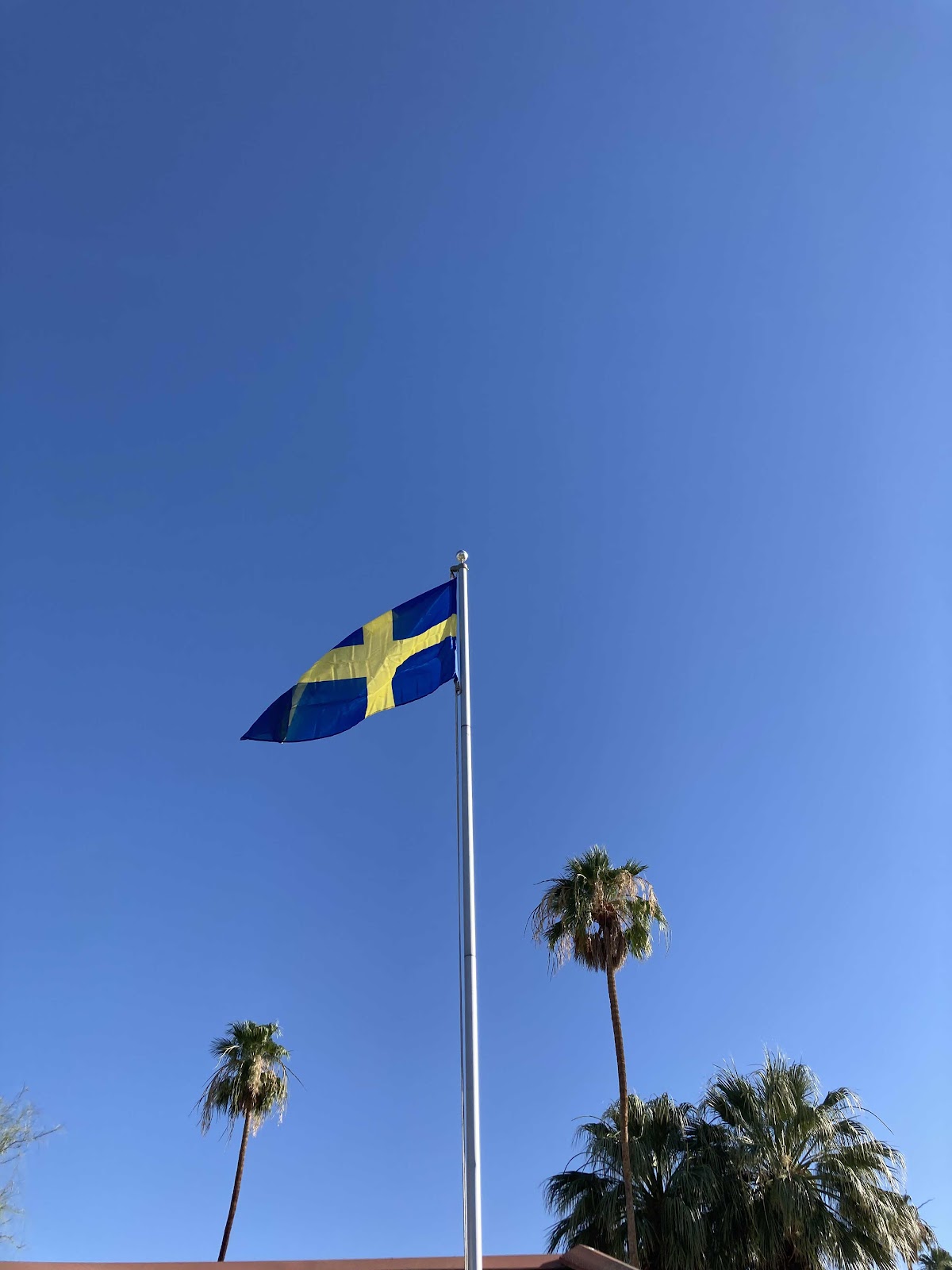
Sveriges Nationaldag. Flying today the Swedish colors in commemoration of my great-grandmother. She came from Skåne to Minnesota and to the scandal of both families, married a NORWEGIAN. (We commemorated HIM on Syttende Mai….) my Mother’s Scandinavian people and my father’s Irish people produced me. I am my own distant cousin. Next foreign flag: France on Bastille Day.

Thursday, December 24, 2020

Bah Humbug!

 Summary:  tomorrow is Christmas day. As I've done for most of the 31 years that I have been admitted to the practice of law, I will spend at least a part of Christmas Day in my office, were at least briefly I can find refuge from the stress and anguish that always seems to happen on Christmas Day. In my office, in the silence of the day, surrounded by books and other tools of the trade of a lawyer, I can find, no matter how briefly, a sense of peace that may enable me to get through the day.

Cathedral City – December 25, 2020. For me, there is no Christmas this year. No Christmas cards, no presents, no family gatherings, no friends. No parents. I knew it was going to be a tough Christmas when my mother passed away in January of this year. I knew that Christmas would be even tougher when I lost my best friend in this desert to what appears to of been a thoracic aneurysm two days before my birthday. Add to that the fact that most of my family seems to have turned its back on me, and it may be understandable that my reaction to Christmas, 2020 is an unfootnoted "bah, humbug."

Today, as at every Christmas for the last 20 years, while I was out and about, I saw one of the Coachella Valley's population of homeless people, this one walking along Highway 111 in front of the shopping center at the corner of Date Palm Drive, pushing a shopping cart with the kind of weary dignity that seems to be the hallmark of every un-housed person one sees at this time of year.

There, but for the grace of God, go I.

And so I say, again, "Bah, humbug."


I cannot know why this year should have been so un-footnotedly awful. All of us have had to live with the unfortunate reality of the worst pandemic in our lifetimes, made even more so by the feckless, incompetent, unhinged, well-nigh-treasonable "leadership" of Donald Trump. Never has a president so merited arrest, trial, conviction, forfeiture, and imprisonment as this one.

We can but hope that the incoming administration of Joe Biden and Kamala Harris will not be moved by fear of the Trump base, but will be attentive, rather, to the anger of the large majority of Americans and of our allies who are clamoring to see Trump and his enablers held accountable for their manifest crimes and iniquities against the United States and against our allies.

But, more to the point, we, particularly those of us who are Conformist in our Religion, should always remember that ultimately, man proposes and God disposes. The ultimate answer to all our prayers is either "yes," "no," or, "wait." Now it may seem that an acknowledgment that God is in control is nothing more than a copout, an easy, fatalistic, abdication of our personal responsibility.

Yet, as we come into this Incarnation season, when, on the morrow, we commemorate the Incarnation of God Godself in the flesh of Jesus Christ our Savior, we must acknowledge, that, as difficult as it may seem, the Incarnation is the passionate reaching out of God to the People of God. God's passionate love for us is passionately expressed in the Incarnation, Passion, Resurrection, and Ascension of  He Who bears us all in His pierced hands.

 Yet still, faced with all that one has gone through this year, one still may be excused for saying "Bah, humbug," while paradoxically saying, as it is quoted in the Gospel according to St. Matthew, "O my Father, if it be possible, let this cup pass from me," if it be God's will. Matt. 26:39.

Merry Christmas to you all.

Saturday, November 7, 2020

MY COUNTRY, A PROMISE OF REDEMPTION

 Summary: Joe Biden became president-elect today. For Joe it has been the crowning achievement of a half-century of public service. For vice president-elect Kamala Harris, it’s something a little bit more.  Kamala, or as some of us refer to her, somewhat avuncularly, particularly after her debate with outgoing vice president Mike Pence, as “Momala,” for the steely expression and reproving tone that accompanied her admonition “I’m speaking,” when he tried to interrupt her during their debate, will be a breaker of glass ceilings in a pronounced way. The first Black woman, the first South Asian, the first woman, to serve as vice president of the United States. All in all, many of us are feeling a kind of relief today after four years of Donald Trump, over a year of a hypertrophied election campaign, nearly a year of the pandemic, and the last week of almost unspeakable election tension.

---------------------------------------

Cathedral City, Saturday, November 7, 2020 –- It’s over. 

After more than a year and a half of pre-election posturing, after nearly a week of almost unspeakable tension and drama in the actual election process, it’s all over, bar the shouting and the results from as yet uncalled battleground states.. 

 Joe Biden and Kamala Harris are the President and Vice President-elect of the United States. 

How pleasant it is to pronounce the words "President Biden" and "Vice-President Harris."

We may perhaps be forgiven a few moments of joy. After four years of the unspeakable, unthinkable, frankly unwatchable, presidency of Donald Trump, American democracy, that hard-pressed, oft maligned, abstraction, has proven more resilient than we had given it credit for being. Thus, before Trump and his revanchistes attempt some dirty tricks this afternoon, this evening, or tomorrow, we may greet with a passing, indulgent smile, the celebrations that have occurred and which are breaking out in cities across the United States and among our allies.

For those of us who have been largely consumers and end-users of politics during these tumultuous times, the coming of Joe Biden and Kamala Harris will be greeted with more hope and more anticipation than the coming of any presidency since that of Bill Clinton in 1992. Indeed, we will probably expect more from Joe Biden and Kamala Harris then we expected from Barack Obama and Joe Biden when they took over in January of 2009.

Of course, the expectation game is a common one in American politics. When George Dubya Bush became president in 2000 after a questionable election and questionable intervention by SCOTUS, his partisans rather giddily expected a wholesale repudiation of all of the works of the previous Bill Clinton ministration. ABC anything but Clinton, was their mantra. Similarly, the Trump administration appears to be guided by the mantra of “undo anything of Barack Obama’s.”

For Democrats, the expectation, come 2021, will be that much of the early months of a Biden administration will be involved in restoring those Obama initiatives which Trump and his enablers sought to undo at every turn. 

Most Democrats will be looking for a Biden administration to rejoin promptly the Paris climate accord.

 Most Democrats will be looking for a Biden administration to reverse Trump’s anti-immigrant initiatives, and to unbuild Trump’s ridiculous border wall that has been demonstrated not to work. 

Most of us probably expect that these iterations or initiatives will be set in train within the first hundred days of a Biden administration.

But, as much as Democrats of all types will have a long list of expectations; they must be prepared to temper those expectations with a sympathetic, pragmatic understanding of reality.
Our Aotsunami (Big Blue Tidal Wave) did not materialize in quite the fashion we had hoped. We will have a Democratic president, we will have a Democratic House, but unless Raphael Warnock and Jon Ossoff prevail in their runoff elections in Georgia in January, the Senate will remain in Republican hands. That means that, again, unless Raphael Warnock and Jon Ossoff are successful, Mitch McConnell will still be a one-man barrier to getting things accomplished. Thus, Democrats need to rally to Joe and Kamala rather than falling into the Democratic temptation of wagging fingers and criticizing the president of their own party because he has not brought about utopia in a day.We must not live down to the traditional Democratic stereotype of carping on the limitations our victory and crapping on those at the top of our ticket.

Indeed, utopia may be unattainable until and unless a Biden Justice Department is able to stamp out the wave of Trumpist revanchisme that, as former counterintelligence analyst Malcolm Nance warned us on Real Time with Bill Maher, last Friday night, might well take the form of a low-level paramilitary insurgency. Biden’s Justice Department and law enforcement agencies in the several states will need to pay close attention to any signs of such insurgency, and to any signs of other treasonable Trumpist conspiracies.

Moreover, it is fairly clear that unless there is a successful intervention by Republican allies of Donald Trump who are willing to speak truth to what still imagines itself to be power, Trump himself will try every means available to delegitimize this election. We had hoped for a lot less closer an election then we had. We had hoped that Aotsunami would sweep away not merely Trump but the Republican majority in the Senate and a large part of the Republican minority in the house. Unfortunately, the Big Blue Tsunami proved to be not tsunami, but a Little Blue Sazanami, the pretty, small waves ginned up by a zephyr, as most elections actually tend to be.

Nonetheless, Joe and Kamala should take office and govern as if they had come in riding a landslide. When timorous Democrats are foolish enough to complain to Joe and Kamala about the closeness of their election, Joe and Kamala should respond with the immortal words of California twice-Governor Jerry Brown, “we won, didn’t we?” They should, ironically enough, take a lesson from their immediate predecessor, Donald Trump, who governed as if he had a landslide when in fact the only reason Donald Trump was ever president in the first place was because of that ridiculous relic, the Electoral College, a foolish holdover of the slave power that should have died with the Confederacy at Appomattox in 1865.

At all events, Joe and Kamala need to govern on behalf of the broad majority of Americans who want to return to the civil society and politics of the Reagan-Bush-Clinton-Busch-Obama years.
While 40% of Americans have sold their souls to Donald Trump, at least 60% of us would like to be able to go about our lives free from the kind of tribalist totalitarianism that Trump and his followers represent. That is the majority to which Joe Biden and Kamala Harris should govern.

Utopia will not be achieved in a single day.
But we may hope that Joe Biden and Kamala Harris may set this country on a necessary path of recovery from the gross aberrations and organized treason that characterized the four years, the four excruciating, the four embarrassing, the four tooth grindingly awful years of Donald Trump. We must so erase the baleful legacy of Donald Trump and of Trumpism that it can never rear is disgusting head in our country again.

So, for a few minutes we can rejoice. But the challenge is still before us. Let us rise to meet it and beat it.

--------------------------------------------------------------
Paul S. Marchand, Esq. is an attorney who lives in Cathedral City and practices law in the adjacent Republican retirement redoubt of Rancho Mirage. He has been a steady Biden loyalist since the President-elect first announced his campaign. He has little patience for Trumpism, for Republicans, and for traitors. The views contained herein are his own, though he rather expects that they are shared, to a greater or lesser extent, by roughly 60% of the American people. Right now, the other 40% don’t matter.

Monday, October 12, 2020

OCTOBER 12: NEITHER COLUMBUS DAY NOR INDIGENOUS PEOPLES’ DAY; WHY NOT CALL IT ENCOUNTER DAY?

Summary: Every year at Columbus Day, or perhaps, more accurately, Encounter Day, we get our knickers in a knot.  Should we embrace a breast-beating white liberal guilt posture of anguished handwringing and so-called political correctness, or should we fall back on the triumphalist Eurocentric narrative so many of us learned in school?  The day long ago set aside to commemorate the first coming of Columbus to the New World has become an ongoing controversy.  Whose day is it?  Do we celebrate the exploring spirit or do we mourn for our First Peoples?  Does the celebration of the one preclude sober reflection about the fate of the other?  Columbus Day/Encounter Day is, and will always remain, a paradox.  Perhaps we should call the commemoration by the more neutral, more fitting, title of Encounter Day.
--------------------------------


Cathedral City, October 12, 2020- Today was traditional Columbus Day. It is theoretically supposed to commemorate the achievement of Christopher Columbus, a Genoese navigator (and possible Sephardic Jew) who, by sailing across the Atlantic in the late summer and early fall of the Year of Grace 1492, proved what had long been believed and generally accepted in European thought: the sphericity of the earth. Italy and Spain both named warships for the Admiral of the Ocean Sea, and there have been a raft of ocean liners named for him as well.

Commemoratively named warships and ocean liners notwithstanding, the view of many Americans of this day is colored, so to speak, by an ironic New Yorker Columbus Day cartoon of some notoriety depicting two American Indians standing in the underbrush by the shore of a Caribbean island.  From three high-castled ships anchored offshore, boats are rowing toward the beach.  In the lead boat, an explorer (presumably Columbus) stands, holding a flag.  The caption of the cartoon has one Indian saying to the other something like "now might be a good time to review our immigration policies."

Yet, after 500 years, it is too late for the native people in the underbrush to review immigration policies. Now in the last generation, there is been a great deal of white liberal guilt, pearl clutching, handwringing, and revisionist history that has arisen around October 12, the Day of the Race, Columbus Day, or, as politically correct legislative bodies around the country now wish to call it, Indigenous People’s day.

Permit me to suggest that if we must rename the commemoration of the arrival of Columbus’ Flota (or maybe with just three ships, it merits being described as a flotilla) at San Salvador in the Bahamas, we should perhaps try to commemorate the encounter itself, and refer to October 12 not by some Eurocentric, triumphalist description as Columbus Day, or by some politically correct moniker such as Indigenous Peoples’ Day, but by the more neutral and more historically just appellation of “Encounter Day,” even as we remember the New Yorker cartoon with its Indians along the shoreline discussing the importance of reviewing their immigration policies.

The cartoon in question strikes us as funny because we know the history of the 500-plus years since Columbus' arrival in/encounter with the New World triggered the greatest völkerwanderung -a vast migration of peoples- in the recorded history of the world.  Since then, millions of immigrants from all over the world have made their way to the Americas, and the history of their interaction with those who came before has been checkered at best.  Yet, despite all the finger-wagging going on in some quarters, völkerwanderungen themselves are morally neutral phenomena.

For, in the last analysis, we Americans are all descendants of immigrants from elsewhere, even the ethnic group Columbus first identified as “Indians.” If my white ancestors came here as part of the Atlantic migrations, my Indian ancestors arrived here tens, perhaps scores, of thousands of years ago, presumably across the Bering land bridge from Asia, and are still ultimately immigrants.  The term "Native American" is thus something of a misnomer, a fact Canada recognizes by designating her Indians and Inuit as "First Peoples."

Still, by the time the first Europeans reached America -whenever that may have been, but certainly well before Columbus- the Indians of the Americas had established a lengthy tenure of occupation.  Of course, we should remember that the tenure of European occupation in the Western Hemisphere did not begin with the Colombian Encounter on October 12, 1492. In fact, we cannot know when the Europeans first encountered the Western Hemisphere. Some suggest that there may have been Egyptian, Carthaginian, or Roman expeditions to what is now the New World. Irish tradition has it that St. Brendan sailed to the New World with 15 monastic companions in an Irish curragh sometime in the early part of the sixth century.

More reliable, archaeologically-backed research indicates that the first European encounter with the Americas which we have a strong empirical basis to believe actually happened was that of Bjarni Herjólfsson in the year 986. Originally chronicled in the Norse Groenlandinga Saga, Herjólfsson’s voyage has been lent credence by the archaeological evidence of a Norse settlement at L’Anse aux Meadows on the island of Newfoundland. Established around the year 1000, L’Anse aus Meadows, together with the Norse settlements in Greenland, establishes a European tenure of occupation in the Americas stretching back more than a thousand years.

No matter whose tradition one accepts, the history of the European-American encounter is more complex and more nuanced than our politically correct historical revisionists might like to believe.  The Americas were not -as generations of American schoolchildren were once taught- an empty wilderness, but a landmass populated by a mass of humanity more diverse by far than Europe itself.  By 1492, the social development of the Americas ranged from primitive hunter-gathering groups through complex state societies ranging from the mound-builder descendants of North America and the Méxica peoples, to the South American empire whose Inca inhabitants knew it as Tahuantinsuyu, the Four Quarters of the World.

Within two centuries of the Colombian Encounter, all of this had gone. 
The westward migration, the völkerwanderung triggered by Columbus' voyages had grown from trickle to flood.  Wave after wave of migration, particularly to the settlement colonies of British North America, coupled with superior weapons technology (coupled with a disturbing European willingness to use it: Norwegian scholar Helge Ingstad once declared that Columbus had succeeded largely because he and his fellows had firearms.), Superior agricultural and industrial technology, and the spread of European diseases -trivial childhood ailments to whites, fatal to unexposed Indians- together with firearms and edged weapons of Toledo steel, tipped the balance decisively in favor of the pale invaders from across the water.

Thus the history, and thus the deeply conflicted emotions that swirl around any October 12 observance.  Is it Columbus Day?  Is it Dia de La Raza/Day of the Race?  Is it Indigenous Peoples Day?  Whatever one calls it, October 12, or Encounter Day, as I prefer to call it, can be relied upon to pit the Sons of Italy celebrating one of their own against Native American groups calling attention to what has been called "half-a-millennium of resistance."   

Despite the facile characterization of the pale people from Europe as eager perpetrators of “genocide,” we should be chary of attaching such a label to what transpired in the Western Hemisphere. Though the statistics of morbidity among indigenous peoples are certainly the statistics of apparent genocide, we need to be aware that genocide, in international law as defined by Raphael Lemkin, the originator of the concept of genocide, is itself a specific intent crime, i.e., the deliberate, non-negligent, non-accidental, extermination of a particular people, in whole or in part.  Though we may be appalled at the morbidity statistics, the evidence suggests that the butcher’s bill was inflicted as the result of negligence, inattention, and a lack of knowledge rather than as the result of deliberate policy, and thus does not rise to the level of Genocide as that term is understood in international law.

Thus, as always, the truth lies somewhere in the middle, in that no-man's-land to which moderates and truth-seekers -and indeed, most of us- are exiled.  Do we celebrate the human achievement of the explorers and the immigrants, or do we weep for our Indian ancestors?  Do we call attention to the evils the explorers so often brought in their wake, or do we celebrate the achievements of our First Forebears?

The answer is: all of the above.  We cannot reverse the pragmatic sanction of history; the völkerwanderung that brought my European forebears to the Americans is as irreversible as that which brought my Indian ancestors to this place.  The peoples have mixed too much to separate them; the rate of intermarriage among the Cherokee, for example, is close to 100 percent.  Now is no longer an opportune time for the Indians in the underbrush of the New Yorker cartoon to discuss immigration policy.  The invaders cannot be marched back onto their Nãos, caravels and Mayflowers, their Susan Constants, their Godspeeds, and their Discoverys, or even aboard the White Star liner Oceanic, which brought my Limerick-born Irish grandmother across the Atlantic in 1913, and packed back whence they came; their bones and the bones of their children have, as much as the bones of the First Nations, also become part of this land.

Nor can we forget the other ramifications which have preceded from a biological phenomenon which has become known as the Columbian Exchange.
Without the Columbian Exchange, the cuisines of Europe would be innocent of such now-integral foods and stimulants as the potato, the tomato, corn (a word which the British, who cannot seem to handle their own language, use to describe the grain properly known as “wheat.”) chocolate, vanilla, and tobacco. Similarly, without the Columbian Exchange, the tables of the New World would entirely lack such staples as citrus fruits, apples, bananas, mangoes, onions, wheat, rice, and that staple of insomniacs everywhere, coffee. Indeed, until the arrival of Hernán Cortés, the horse, which had originated in what is now North America but had become extinct there, had been unknown to the indigenous peoples of the Western Hemisphere.

Moreover, while the pale invaders from across the water must take responsibility for such diseases as the measles, the emergence of syphilis, which for almost four centuries cut a horrifying swath across Europe, can be laid at the door of the indigenous peoples of the Western Hemisphere. In short, the Columbian Exchange, like so many other phenomena throughout history, in the end must be accounted morally neutral. We should be foolish indeed to judge either Christopher Columbus or the Columbian Exchange by the purportedly modern standards of the 21st century. As Winston Churchill observed in 1938, in our own time, “we have seen archbishops pistolled in the nape of the neck in the warm, brilliantly lighted corridors of modern prison.” We have seen women and children machine gunned and hacked to death in their scores, hundreds, and thousands. We possess the capacity to extinguish all life on this planet. We thus have little claim to vaunt some kind of superior civilization to that in which Christopher Columbus, or his contemporaries the Méxica tlatoani Motecuhzoma Xocoyotzin, or the Sapa Inca Huayna Capac, lived.

The invasion of the pale people from across the water has been a success.  Generations of interpenetration have produced a people that like mythic Coyote -the culture hero of many tribes- is one of shape-shifters.  Millions of Americans carry the blood of both sides in their veins; millions of us are at once both the invading European and the resistant Indian.  In a time of shape-shifting and mixing, Columbus Day, or Encounter Day, like Coyote, must be a shape-shifter.  It must be an occasion for celebrating the nobility of the exploring spirit, but also for reflection on the duties we all owe to one another as common human inhabitants of the place we all call home.

As Burkean conservatives and Gladstonian liberals, and as Democrats, we must particularly be attuned on Columbus/Encounter Day and every day to what our communities are telling us.  We are a coalition -a movement- composed of communities and tribes and lineages of every sort and condition.  We march with labor, but also support the right of Indians to be accounted as first class citizens of the commonwealth.  We confess many faiths, and none at all.  We acknowledge the right of many Americans of faith to oppose marriage equality within the context of their own churches, but we also insist that America's queerfolk be treated as first class citizens, too.  We embrace inclusiveness, knowing that ours is the harder choice and the nobler path, one from which the fearful of change turn away.

Columbus/Encounter Day has become a paradox, laden with so many layers to deconstruct the debate will continue long after those currently engaged in it have passed out of this world.  It is part of our larger American paradox, in which, as Babylon 5 writer J. Michael Straczynski once observed, "The past tempts us, the present confuses us, and the future frightens us. . And our lives slip away, moment by moment, lost in that vast terrible in-between....."  Whose day is Columbus Day?  Whose day is Indigenous Peoples' Day? Whose day is Encounter Day? It belongs to all of us, a day on which, perhaps more than on any other holiday or commemoration, we need to reflect on who we are, where we've been, and where we're going.

-xxx-

PAUL S. MARCHAND is a pale, European-looking, attorney.  He lives in Cathedral City, where he served two terms on the City Council, And practices law in the adjacent Republican retirement redoubt of Rancho Mirage.  Thanks to an Act of Congress only a lawyer could love, and the fact that he lives on Indian leased land, his government considers him an Indian living on a Res.  Go figure.  The views herein are his own, not those of any jurisdiction, agency, entity, club, or other organization, and are not intended as, and should not be construed as, legal advice.

This post is a revision of an earlier post published at this time in the year 2016 and modified and republished every October 12th since then.  Since knickers are still in knots, it remains timely.